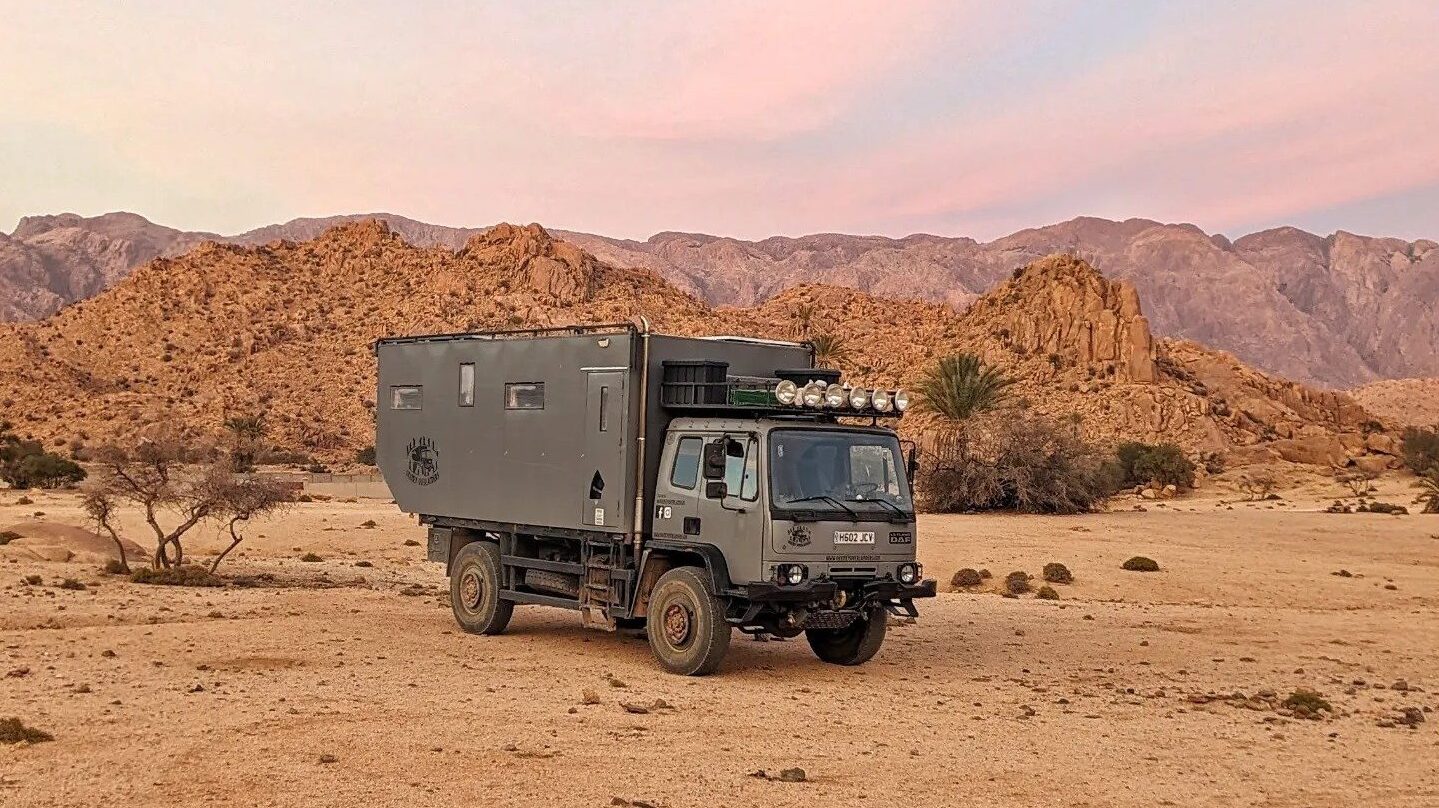

One of the most common jobs we’re asked to carry out during our work season is the Leyland DAF T244 gearbox conversion, swapping the original Spicer 5-speed gearbox for a higher-ratio ZF S5-42 with an overdrive fifth gear.
The ex-military T244 comes fitted with a Spicer gearbox as standard. It’s a heavy-duty unit, well suited to low speeds, heavy towing, and serious off-road use. For military applications, it makes perfect sense. But a lot of T244s are no longer being used the way the military intended, and that’s where its limitations start to show.
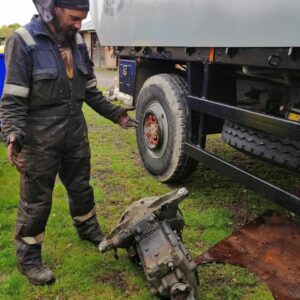
Why We Did the Gearbox Conversion?
When we were covering long distances and doing a lot of motorway driving, we found ourselves either slower than the general flow of traffic or pushing the truck hard just to keep up. That meant higher revs, more noise, and fuel disappearing far faster than we’d like.
On more than one occasion, commercial wagons didn’t realise how slow we were moving until the last moment, forcing them to change lanes at the last minute. It wasn’t comfortable, and it wasn’t ideal from a safety point of view either.
It wasn’t like we wanted to turn it into a race truck; we simply wanted usable road speed, lower engine revs, and better fuel efficiency. After seeing a couple of other owners move to higher-ratio gearboxes, we decided to do the same.
The ZF S5-42 Gearbox Conversion
After a fair bit of research, we opted to convert our own truck from the original Spicer 5-speed to a ZF S5-42, another 5-speed gearbox but with higher overall ratios and an overdrive fifth gear.
In practical terms, this means:
- You lose the very low crawler first gear.
- Fourth gear becomes the 1:1 ratio (instead of fifth).
- Fifth gear is an overdrive, giving a higher cruising speed.
This change gives a much higher usable top speed and lowers engine revs at motorway speeds. However, because you lose that ultra-low first gear, it becomes important to understand and use the truck’s high and low range gearbox properly.
Living Without the Crawler Gear
In reality, losing the crawler gear hasn’t been a problem. Switching into low range provides a good spread of lower ratios, and we often used it for long, slow climbs.
On winding mountain roads in places like Italy, staying in low range can actually be an advantage. You’re unlikely to be travelling faster than the mid-30s anyway, and the gearing is better suited to sustained climbs. We often sat in low-third and just kept climbing, rather than constantly shifting between second and third in high range and losing momentum.
Real-World Performance Gains
With a standard military-spec T244 on 12R20 tyres, at 2000 rpm:
- Spicer gearbox: ~38 mph
- ZF S5-42 gearbox: ~51 mph
That difference has a big impact on drivability. Lower revs mean:
- Better fuel efficiency
- Less engine wear
- A quieter cab
As a real example, our own T244 would sit comfortably at 50–56 mph, returning around 15–16 mpg. We could also play music and hold a conversation while driving, which wasn’t always possible previously.
There’s also a significant weight saving. The Spicer gearbox weighs around 180 kg, while the ZF unit is closer to 80 kg, which matters if you’re trying to keep overall vehicle weight down.
Another, arguably less important difference is the shift pattern itself. The original box shift pattern has 1st to the back and left, 5th to the back and right and reverse to the front and left; whereas the ZF box shift pattern has 1st to the front and left, 5th to the front and right and reverse to the back and right. The pattern is also much tighter with the ZF box, making it much less of a workout to change gear.
Why Not Just Fit Bigger Tyres?
Another common modification is switching to 14R20 tyres, which gives around 44 mph at 2000 rpm. That’s an improvement over standard, but still not comparable to the gearbox conversion.
Larger tyres can also affect manoeuvrability and may cause tyre scrubbing, particularly at low speeds or on tight turns. For most people, the gearbox upgrade offers a better balance of performance and practicality. Fitting both the larger tyres and the uprated gearbox is also an option but the combined higher gearing can impact on low-speed and off-road driving. This requires further reliance on the low-range side of the gearbox.
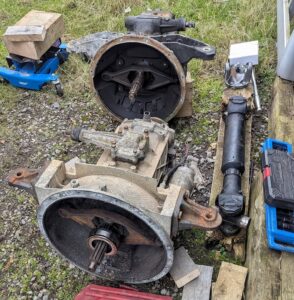
Making the Gearbox Conversion Easier
The early T244 gearbox conversion often required prop shaft modifications, which varied depending on the age of the vehicle, and a fair amount of custom fabrication to make the ZF gearbox fit.
Over time, we’ve developed a dedicated conversion kit that makes the swap far more efficient and repeatable. This reduces installation time and avoids unnecessary modifications to the rest of the drivetrain – ideal for our customers. It seems to be relatively popular anyway, so far (as of the end of 2025) we have carried out 23 conversions, and have 10 more in the schedule for 2026!
Gearbox Sourcing
The ZF gearboxes we use come specifically from Leyland DAF FA45 trucks. Other ZF boxes can work, but they usually require additional changes, such as modifying mounts or adapting clutch components. If you have a T244 with a PTO you will also need to make sure the incoming box also has one, as the PTO fitted to the Spicer gearbox will not fit the ‘new’ ZF box.
Gearboxes are sourced by the owner, typically from a scrapyard or breakers yard. We’re happy to:
- Offer recommendations
- Carry out remote compatibility checks
However, we can’t guarantee the condition of a second-hand gearbox we haven’t supplied. For peace of mind, gearboxes can be professionally reconditioned. At the time of writing, we’re also working on building a small stock of reconditioned ZF S5-42 gearboxes, checked and rebuilt by a specialist.
Important Parts to Check when Buying a Gearbox
When sourcing a ZF gearbox, it’s vital to make sure nothing important has been removed. We’ve had gearboxes arrive missing key components, sometimes without the buyer or seller even realising they’re needed.
Make sure the gearbox comes with:
- Chassis mounts: These support the gearbox and rear of the engine. The job cannot be done without them.
- Selector fork
- Stabiliser bracket
- Slave cylinder mount
- Clutch fork: Yes, this really has been missing before.
The Gearbox Conversion Costs (Approximately)
The cost can be one of the biggest, deciding factors when it comes to carrying out non-essential work on your vehicle, but we do our best to keep costs as low as we can.
- Conversion kit: £650 (plus postage if you are doing the work yourself)
- Gearbox: £300–£400 second-hand from a breakers yard OR £1,300 + shipping for a reconditioned box.
- Clutch pack: ~£280 (recommended, we’ve pulled out some very rough clutch plates)
- 80W-90 gear oil (4 litres): £20–£40
- DOT 4 brake fluid (1 litre): ~£10
- Labour: £45 per hour (typically 12–15 hours)
DIY vs Professional Fitting
It is possible to carry out the gearbox conversion yourself. We can even supply the conversion kit with basic instructions for competent DIY mechanics.
That said, this is a critical drivetrain component. If it’s done incorrectly, the consequences can be serious. It’s also worth bearing in mind that this isn’t a small job, and it’s not reasonable to expect extensive free technical support for a weekend DIY install when the work could be completed by a professional (either by a garage/mechanic happy to carry out non-standard/modification work, or ourselves).
For most people, having the conversion carried out professionally offers peace of mind and ensures everything is set up correctly from the start.
Conclusion
For many Leyland DAF T244 owners, the ZF S5-42 gearbox conversion gives a far better balance between off-road capability and regular driving. It turns the truck from something that feels under-geared and slow on the road into a vehicle that’s more comfortable, safer in traffic, and noticeably more efficient over long distances. For overland travel and expedition builds, those changes make a genuine difference to how enjoyable the truck is to live with.
As with any major modification, it’s important to be realistic about how you use your vehicle. This conversion won’t suit every owner, but for those with trucks spending a lot of time on the road, it’s proven to be a worthwhile and well-tested upgrade. Understanding your gearing, using low range effectively, and fitting the conversion correctly are all key to getting the most from it.
If you’re interested in the conversion, you can get in touch to order a conversion kit (subject to availability), or arrange for us to carry out the work if there’s space in our schedule. We’re always happy to talk through compatibility, options, and whether the conversion makes sense for your particular truck and travel plans.
To find out more about our work and truck projects, check out the work, and truck sections of the website.


