
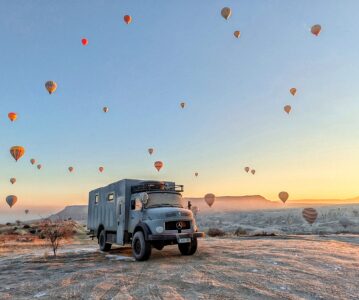
After spending a good few winters overlanding through southern Europe and Morocco, we decided to choose somewhere different to test out our newly-build overland truck: Turkey.
Turkey had been sitting on our ‘future adventures’ list for quite a while, so for the winter of 2025-26 we finally decided it was time to head east. We split our time between Greece and Turkey and spent eight weeks introducing ourselves to this vast and varied country.
Turkey sits in an unusual position between Europe and Asia, with layers of history, cultures and landscapes all colliding together. The country is best known for places like Istanbul, the hot air balloons of Cappadocia and the turquoise beaches along the south coast. Travelling overland gives you the chance to experience a side of Turkey that many tourists never get to see.
Before arriving, we’d heard mixed opinions from other travellers. Some people described the driving as chaotic, others warned us about complicated bureaucracy, difficult border crossings or huge cultural differences. In reality, we found Turkey surprisingly easy to travel through. The roads were generally excellent and park-ups were easy to find. The people were some of the kindest and most welcoming we’ve met anywhere on our travels.
What really stood out to us though was the scale of the country. Turkey is absolutely massive, and despite travelling for two months we still only explored a relatively small section of it. From underground cities and ancient ruins to mountain roads, beach park-ups and endless glasses of Turkish tea, overlanding in Turkey quickly became one of our favourite trips so far. But before getting into some of our favourite places, here’s some practical information that might help if you’re planning to drive to Turkey yourself.

Entering Turkey Overland
We crossed into Turkey from Greece at Ipsala. Before even reaching the border booths we ended up stuck in long queues caused by Greek farmer protests, but normally you don’t have to start queuing until you actually reach the border point.
At the Greek exit point, we moved into the middle lane, set aside for buses and campervans. The system felt slightly chaotic at times and it seemed like the staff had half-forgotten about that middle section. I actually had to walk over to another booth to get the barrier opened!
The crossing itself was fairly straightforward though. First came passport checks and a quick look around the vehicle. After driving across to the Turkish side we stopped again for another passport check and a photo. This was followed by a brief vehicle inspection where they checked our outer lockers, and confirmed we were a camper.
After that, we parked up and headed into the building on the left-hand side to arrange vehicle insurance. Three months was the minimum period available and cost us around €184.
One thing worth noting is that after buying insurance, we still had to return to the vehicle check booth so they could inspect the insurance documents and V5. It seemed like they intentionally let vehicles continue through first, so they didn’t block the inspection lane while arranging insurance.
Despite the slightly confusing layout, everybody was friendly and helpful throughout the process.
Leaving Turkey
Crossing back into the EU was much simpler than we expected.
We passed through the Turkish side relatively quickly. There was a passport check, an exit photo and a quick vehicle registration check. The registration check appeared to be linked to tolls and speeding fines, making sure no unpaid charges were attached to the vehicle before leaving the country.
After crossing the ‘no man’s land’ bridge we joined the queue for the Greek border. Larger overland vehicles didn’t need to join the commercial truck lanes and instead queued with the normal cars.
Everything moved at a relaxed pace but we were still through the border and back into Greece in under an hour.
Tolls in Turkey
If you plan to use toll roads in Turkey, or simply want to avoid accidentally collecting fines, it’s worth sorting out a toll tag when you enter the country.
We bought ours at the post office in Ipsala, just beyond the border crossing. The tag itself cost around £1 for our Class 2 vehicle and we preloaded roughly €25 onto it. Apparently, you can top them up online, but we heard this can sometimes be difficult with foreign cards, so topping up at another post office is probably easier.
If your balance goes negative, you usually have a short grace period to pay before fines are added. We never had to test this ourselves though.
Apart from crossing the Çanakkale Bridge, which cost us around €23.50, we mostly avoided toll roads altogether.
SIM Cards and Internet
We actually didn’t need to buy a Turkish SIM card because our EE roaming package covered Turkey within our normal UK contract.
Most travellers we met were using either Turkcell, Vodafone Turkey or Türk Telekom SIM cards. They all seemed reasonably easy to get hold of, although not as cheap as you would expect.
If you rely heavily on mobile data for work, it’s probably worth checking roaming policies carefully before arriving. Turkey often sits outside standard EU roaming agreements, and a couple of people told us their Starlink stopped working.
Turkish Culture and Hospitality
One of the things that stood out during our time in Turkey was how genuinely kind and welcoming people were.
We lost count of the smiles, waves and random acts of generosity. People regularly stopped to ask whether we needed anything and gifted us fruit and local produce. Some simply wanted to chat despite there often being no shared language.
Learning even a few Turkish words made a huge difference and people always seemed genuinely pleased that we were trying. “Teşekkürler”, meaning “thank you”, was probably our most used bit of Turkish.
Turkey is still a predominantly Muslim country and, outside of tourist-heavy areas, people generally dress relatively conservatively (although the winter weather may also have played a part in this). That said, we never felt uncomfortable or unwelcome. As with travelling anywhere, simply being respectful of local culture goes a long way.
Driving in Turkey
The roads throughout most of the country were surprisingly good. Even many mountain and coastal roads were well surfaced and easy to drive.
The main thing we learned very quickly was how slippery some of the roads become when wet. Several rural coastal and mountain roads seemed unusually greasy in the rain and we know of multiple vehicles that have slid off or tipped over after losing traction.
We even had a couple of moments ourselves where the truck slid slightly on corners despite driving cautiously!
Traffic itself wasn’t particularly stressful. In towns and cities you just need to stay alert. People frequently park in the roadside lane or pull out unexpectedly. We found it easiest to stay in the middle lane and let everyone else weave around.
One thing we really appreciated was how patient people generally were. At one point we became completely stuck in a small town because cars were double parked along a narrow road and our truck physically couldn’t squeeze through. Nobody beeped or got angry. Shop owners casually attempted to locate the driver, who eventually appeared, apologetically moved his car and life simply carried on.
Parking and Wild Camping in Turkey
Turkey turned out to be one of the easiest countries we’ve visited for finding overnight spots.
We mostly used Park4Night but honestly we probably didn’t need to. There were beautiful park-ups everywhere and we rarely felt unwelcome parking our truck.
We found countless quiet beach spots, lakeside pull-ins and mountain viewpoints. Nobody seemed remotely bothered by our presence.
We still tend to follow a ‘parking, not camping’ approach when staying overnight. This means we generally avoid setting up tables, awnings or spreading ourselves outside the vehicle. In reality, Turkey probably would have been one of the few places where we could have relaxed that rule.
The Turkish themselves clearly love outdoor weekends and caravan culture. It was common to see little caravans parked by beaches or beauty spots waiting for the owners to return.
Travel Costs
One thing that made Turkey even more favourable as somewhere to explore was how affordable day-to-day life could be compared to much of Europe. That said, prices do change fairly rapidly because of inflation, so costs can vary quite a bit depending on when you visit.
Fuel was one of our biggest expenses, although even that felt relatively reasonable considering the distance we covered. Diesel averaged around 98p per litre while we were there. We spent on average £16 a day on fuel for this portion of the trip.
Food shopping was generally very affordable too, especially if you stuck to the more local supermarkets like ŞOK or BİM. Migros tended to stock a wider range of European products, although prices were usually a little higher there.
Some rough grocery prices while we were travelling were:
- Fresh bread loaves for around 15p
- Tea for around 15p a cup
- Potatoes at roughly 40p per kilo
- Chicken breast at around £3.80 per kilo
Because Turkey is a predominantly Muslim country, pork products are fairly uncommon outside of larger supermarkets or tourist-heavy areas. Alcohol is available, although we found it noticeably more expensive than general groceries. We didn’t drink much there, apart from picking up some Raki to take home with us when we left.
Eating out could vary massively depending on where you were. In smaller towns and more local restaurants, food was incredibly cheap. We regularly picked up lahmacun (a flatbread topped with minced meat and herbs) or chicken kebab wraps for around £1.75.
At one local council-run diner we had a full meal for roughly £2.80, which felt almost unbelievable by UK standards. On the other hand, more tourist-focused areas like Göreme in Cappadocia were naturally more expensive. A fairly standard lunch worked out closer to £7.50.
Overall though, Turkey felt like a very manageable country to travel through on a budget, particularly if you kept to the more local towns and shops.

Highlights from Our Turkey Overland Trip
Cappadocia
Cappadocia was every bit as stunning as we’d hoped. Knowing it would be colder inland, we reached the region early in our trip, but it was still freezing. Temperatures dropped to -9°C and it snowed while we were there! Honestly though, I think the winter conditions made it even more magical.
We spent two nights parked between, and overlooking Red Valley and Love Valley before moving down into Red Valley itself for another night. The balloon flights only happened two of the three mornings we were there because of the weather, but watching hundreds of hot air balloons rise through the snowy valleys at sunrise was incredible.
Because it was winter, the area was also surprisingly quiet. We had no issues finding places to park and could properly enjoy exploring the maze-like valleys and rock formations without huge crowds.
Derinkuyu Underground City
Exploring the Byzantine Underground City of Derinkuyu was one of the most fascinating experiences of the trip. While there are around 200 underground cities in Turkey, this one is apparently the largest, that’s been discovered anyway!
It’s hard to imagine how many people once retreated underground in this enormous defensive settlement, built to shelter communities for long periods during invasions and attacks. The underground city spans 18 levels, stretches 85 meters underground, and could house 20,000 people, plus supplies and livestock!
The tunnels and chambers seem to continue endlessly beneath the ground. Wandering through the narrow passageways gives a real sense of how extraordinary the place is. Luckily it’s easy to find your way around as you can follow the coloured arrows to go further down, or back up to the exit.
The entrance fee for foreigners felt a little expensive compared to local pricing (50 lira for locals, €13 (~680 lira) for foreigners. Unfortunately this is becoming common at major tourist sites, so you may need to be selective about where to visit.
In order to visit we parked up at the Hakkı Atamulu Kültür Parkı (38.370008, 34.731694). There wasn’t a huge amount of space, but it was suitable for the afternoon to visit Derinkuyu.
Gallipoli Peninsula
The Gallipoli Peninsula was one of the more poignant stops on the trip. Standing among such beautiful coastal scenery, it’s difficult to fully realise the scale of destruction and loss that occurred there during the Gallipoli Campaign in the First World War.
The southern end of the peninsula is covered with memorials, cemeteries and historic sites connected to the Allied landings and the Ottoman defence. We spent the day walking around, exploring the rugged terrain and visiting the area, mostly around ANZAC Cove.
There’s so much to see that it can feel slightly overwhelming. It would be best to pick a handful of key locations and take your time with them rather than trying to rush around everything.
You are not allowed to overnight at the south end of the peninsula. Instead, many people find suitable spots around the small town of Eceabat. We chose a park-up slightly further to the north, overlooking the Çanakkale Bridge.
Mount Chimera
Mount Chimera was the most unusual place we visited in Turkey.
Natural methane gases escaping through cracks in the rocks ignite when they reach the air. The flames from this reaction have been burning for thousands of years, the phenomenon has even inspired Greek mythological tales!
We chose to walk up from the beach for our visit. This was instead of moving the truck to the official car park where you can only park during the day. Once we reached the entrance we paid our 100 lira each fee, and followed a short but steep and rocky trail uphill to the fires.
The flames are apparently most atmospheric as darkness falls, but we were happy enough with our daytime visit. It was so cool to see this unusual natural phenomenon and definitely work the hike!
We spent quite a while wandering around the ruins nearby and watching the fires flickering out from between the rocks. There were also several resident cats living around the site. They were rather soot-covered and clearly very comfortable curling up beside the eternal flames waiting for attention, or snacks.
The Turkish Coast and Beaches
We’re not particularly beachy people, but there were a few coastal park-ups in Turkey that turned out to be some of our favourites. Even during winter, we managed to swim in the sea several times and spent nights parked right beside empty beaches.
The beach by Perakende was a great stopping point (36.822549, 31.224173). There are miles of empty sandy beach and very few visitors. We were able to park right on a firm part of the beach, swim in the sea and enjoy a stunning sunset looking out over the water. It seems to be quite a popular spot with overland travellers. We met a couple of German campers who had declared the beach home, at least for a night or ten!
İncekum Beach on the edge of Aydıncık was another pretty great spot, and is where we spent Christmas Day. A large section of the dirt carpark seems to be a free campsite (36.148630, 33.362185). While there were a few permanent looking vehicles parked off to one corner there was plenty of flat space. We were happy to spend a couple of days there so we could go for a swim and enjoy the beach.
One thing worth mentioning if you’re considering dipping your toes in Turkish waters is sea urchins. Some beaches had huge numbers of them and standing on one can ruin your trip very quickly. One overlander friend spent weeks struggling to walk after stepping on one. Water shoes are definitely worth carrying.
Another thing to keep in mind when it comes to Turkey’s beautiful beaches is that at certain times of year there may be additional restrictions in place to limit access, but for a very good reason. The beaches are some of the most important breeding and nesting sites for the loggerhead, and the green sea turtle! The nesting season lasts from May to October, with peak hatching times occurring between July and September.
Konya
Konya felt completely different from much of the rest of the country we visited.
Often considered the religious heart of Turkey, it’s best known as the home of the poet and philosopher Rumi, who founded the Mevlevi Order, now commonly known as the Whirling Dervishes. If you time your visit right you can attend a display of the Dervishes at the cultural centre. It costs 300 lira each on a Saturday (or Thursday too in the summer), as opposed to paying €20 for the same show elsewhere which we saw advertised around the city. Buying tickets was a bit confusing but apparently you can get them from 6pm on the day for the 7pm performance – we bought ours at the entrance just before the performance started.
We spent a couple of days exploring the city, visiting Rumi’s mausoleum, wandering through the old market area and attending a Whirling Dervish performance. Coincidental timing meant we were also able to visit the flea market. This was a very authentic local experience. People had rugs spread on the rough ground to display their wares, from spare car parts to kids toys. Most were drinking tea and staying near the numerous small fires lit across the area for warmth.
There’s a very useful free parking area right in the centre of town opposite the Cultural Centre. It made visiting in a larger vehicle surprisingly easy, once we got through the town traffic.
Fethiye
Fethiye is more touristy than many places we visited in Turkey, but it still felt fairly relaxed, especially during winter. The marina, bars and tourist boats were mostly empty when we visited, but the town still had a nice atmosphere and plenty going on.
We enjoyed wandering through the markets, particularly the weekly vegetable market. There were also loads of affordable options for eating out which we did so much more than normal!
We visited the Lycian rock tombs overlooking the town and spent time catching up with other overlanders in the area.
If you’re considering parking up in the huge carpark opposite the market area try to avoid arriving or leaving on market days (Tuesday and Friday). People will park in the tiniest of spaces, blocking you in and making it impossible to go anywhere. We had one car park about two inches from our bumper. Someone else almost blocked our habitation door by dragging a trailer right in front of it!
Lake Bafa
Lake Bafa was one place we hadn’t given much thought to originally but it was conveniently located and our friends had just shared their appreciation for the place, so we thought we’d take a look. We’re glad we did because we had quite an adventure exploring around there!
Originally part of the Aegean Sea, the lake became separated after sediment from the Büyük Menderes River gradually blocked the channel connecting it to the sea. Before getting land-locked the ancient city on the waterside – Herakleia was an important trading and religious location.
The area surrounding the lake is filled with layers of history. Ancient ruins, defensive towers, temples and Roman baths are scattered throughout the nearby boulder fields and hills.
We didn’t have long enough to spend exploring the area but we did enjoy our time, walking and wildlife spotting.
At one point we accidentally encountered a wild boar while walking through the boulder fields! Luckily a helpful local street dog who’d accompanied us on our hike chased it away before we got too close. We also spotted flamingos on the lake and found a porcupine quill, an animal we didn’t even realise inhabited the region.
One of our favourite things about the place was the atmosphere at sunset. Locals arrived carrying camping chairs, flasks of tea and snacks, to sit together watching the light change across the lake.

Places We Missed… But Definitely Want to Visit Next Time
As huge as Turkey is, there was no way we were going to see everything in a single trip. A few places in particular kept coming up in conversations with other travellers and locals, and honestly they all look worth visiting if you get the chance. Some we had to skip because of time, others because of cost or logistics with the truck, but they’re all firmly on the list for next time.
Istanbul
Avoiding Istanbul was probably the most controversial decision we made during our Turkey trip.
So many people have told us how amazing they found Istanbul on their visits, but arriving in one of the world’s largest cities in a big overland truck, right at the beginning of the trip, honestly sounded more stressful than enjoyable at the time, especially when we’re not very city-orientated anyway! That said, Istanbul looks absolutely incredible and it’s somewhere we’d like to explore in the future.
The city straddles both Europe and Asia and is packed with famous sites. There’s the Blue Mosque, Hagia Sophia, the Grand Bazaar and the Spice Market, along with palaces, mosques, and lots of other interesting locations.
Most overlanders we spoke to recommended staying way outside the centre itself and using campsites or guarded parking areas and public transport to get into the city. There seem to be several overlander-friendly parking options on the outskirts where larger vehicles can safely stay while you explore the city without the stress of navigating central Istanbul traffic.
Ephesus
Ephesus was one of the places we seriously considered visiting but ultimately decided against because of the entrance costs. That decision probably sounds ridiculous considering how impressive the site actually is, but the entrance fee for foreign visitors is currently around €40 per person, with extra charges if you want to visit the Terrace Houses as well.
Ephesus is one of the best-preserved ancient Roman cities in the world and was a major trading and cultural centre. The site includes huge marble streets, temples, baths and amphitheatres. It’s also home to the famous Library of Celsus – probably one of the most recognisable ancient structures in Turkey.
You can use the visitor car parks during the day fairly easily, although overnight parking isn’t allowed. The nearby town of Selçuk seems to have several overnight options listed on Park4Night though, where campers are able to park without any hassle.
Göbekli Tepe
Göbekli Tepe is somewhere we only missed because it was simply too far east for this particular trip. The site is considered one of the oldest known monumental religious structures in the world. It dates back roughly 11,000 years, thousands of years older than Stonehenge or the pyramids.
Archaeologists believe it completely changed our understanding of early civilisation. This is because it suggests organised religion and large-scale construction may have existed before settled farming communities. Massive carved stone pillars decorated with animals and symbols have been uncovered at the site, although much of it still remains buried and under excavation.
For anybody interested in ancient history, it seems like an absolutely fascinating place to visit. From what we’ve seen, visitors can park in the main site car park during the day, while some overlanders seem to overnight on open ground along the smaller road running southeast of the archaeological site.
Mount Nemrut
Mount Nemrut looks both incredible, for its location but also for what’s on it. The mountain is famous for the enormous ancient stone statues scattered across its summit, particularly the huge carved heads built as part of the tomb sanctuary of King Antiochus I in the 1st century BC. Many of the statues originally stood upright but now lie partially toppled around the summit, giving the whole place a surreal atmosphere. The heads themselves stand roughly 9 metres high and the site sits at over 2,100 metres above sea level, so conditions can be pretty extreme depending on the season.
This definitely isn’t somewhere to arrive unprepared. Snow, ice and freezing temperatures can make access difficult outside of summer and the road to the summit can become impassable in winter.
You can either park at one of the visitor centres, or drive a bit further up the mountain though the latter option will depend on the road conditions and your vehicle as apparently the road is a bit awkward. Either way there’s still a steep, rocky uphill walk to reach the summit viewpoint.
Most people recommend visiting either at sunrise or sunset when the light across the statues and mountains is supposed to be spectacular. It costs €10 for foreigners to visit, but you can stay in the visitor centre carpark at no charge.
Pamukkale
Pamukkale was another place we genuinely intended to visit before timing got away from us. Translated to ‘Cotton Castle’, Pamukkale is famous for its bright white travertine terraces and pools formed by mineral-rich thermal waters flowing down the hillside over thousands of years.
Above the terraces sits the ancient city of Hierapolis, meaning the site combines both natural scenery and extensive ruins in one location. Visitors can walk barefoot through parts of the terraces and even lie in Cleopatra’s Pool, a thermal pool filled with submerged ancient columns.
The entrance fee has risen fairly significantly in recent years and is currently around €30 per person. This gives you access to the terraces and Hierapolis site, with additional charges for Cleopatra’s Pool. It’s also a bit uncertain as to whether you’ll find the shallow pools full of water. There seems to be times when the water is diverted off to be used elsewhere.
Even so, nearly everyone we’ve spoken to who visited said it was worth seeing at least once. From an overlanding perspective, it also seems fairly accessible. There’s parking available near the site and several camper-friendly overnight options nearby on Park4Night.
Other Useful Things to Know Before Driving to Turkey
Before heading to Turkey there are a few extra things that are worth checking beforehand, especially if you’re travelling in an overland vehicle.
- Visa rules are important to understand before arriving. For UK citizens and most Europeans, Turkey currently allows visa-free travel for up to 90 days within a rolling 180-day period. That means a quick ‘border run’ doesn’t simply reset the clock like it does in some countries. The previous 180 days are always taken into account when you re-enter, like with the Schengen Area.
- Your vehicle is also only allowed 90 days out of 180 which seems to be a shorter allowance than previously given.
- Confirm whether your normal vehicle insurance and breakdown cover remain valid once you cross into Turkey. Ours didn’t, but buying Turkish vehicle insurance at the border was very straightforward.
- Weather conditions are another thing to think about carefully. Along the south and western coast, winter temperatures were generally pretty comfortable, but inland and further east is a completely different story. Central Turkey can get extremely cold and snowy during winter, while some regions become brutally hot during summer.
- Drone rules in Turkey also seem to be stricter than in some European countries. You are generally allowed to fly drones, but there are restrictions around airports, military zones and some archaeological or government sites, so it’s worth researching current regulations before flying.
- Turkey also sits in an active earthquake region. We actually experienced a small earthquake ourselves while travelling up the west coast near İzmir. Luckily it was only minor, it shook the truck about as much as if a cow had decided to scratch itself against the side of it, but it was Stuart’s first earthquake so, once we checked it wasn’t worse elsewhere, it was actually kind of cool.

Would We Return?
We would absolutely visit again. Turkey quickly became one of our favourite countries for overland travel.
The combination of welcoming people, easy travel, varied landscapes, good roads, affordable living, fascinating history and endless wild camping opportunities makes it an incredible destination for anyone travelling by vehicle.
Despite spending eight weeks there, we still felt like we’d only seen the tiniest part of the country. We’d definitely recommend allowing yourself more time than you think you’ll need too. Turkey is one of those countries where plans quickly go out the window once you realise how many amazing places there is to explore.
To read our other full-country guides click here.


