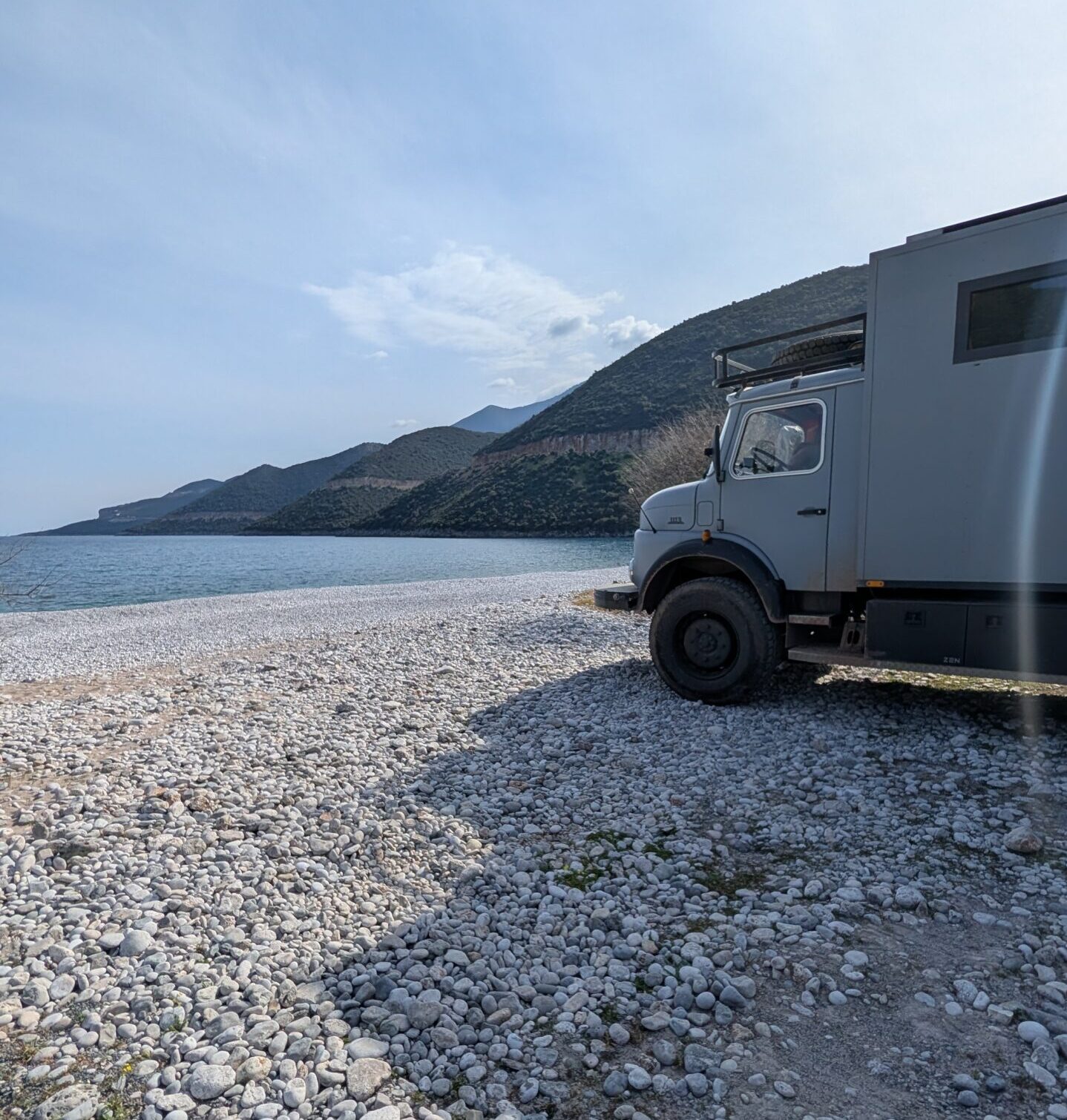

Greece probably isn’t the first country that comes to mind when you think about a winter overland trip, but it turned out to be a great place to explore in our old truck.
We spent part of our winter travelling around Greece after crossing over from Italy. We explored everything from ancient ruins and Byzantine monasteries to mountain passes, hot springs and some seriously beautiful beaches.
Greece turned out to be one of those countries where we could have spent much longer exploring. There was far more to see than we could fit into one winter, but here’s what we discovered along the way.
Travel
Getting to Greece by Ferry
We entered Greece by ferry from Brindisi in Italy, arriving at Igoumenitsa on the west coast.
The ferry boarding process was a little confusing, although I’m not sure how much of that was actually Greece’s fault. It was mostly just incredibly relaxed.
I walked into the main office with our passports to collect our boarding cards, then we drove along to the waiting area, which was essentially just a car park next to the passenger terminal.
We wandered into the terminal and asked what the system was in very broken Italian. The guy cheerfully told us to wait there and someone would let us know when they were ready for us.
Eventually someone showed up and opened a side gate and we were sent through onto the ferry.
I think we’d just got used to ferry crossings being a little more organised, particularly after some of our previous experiences. We’d deliberately chosen the daytime ferry rather than travelling overnight because we didn’t want to pay for a cabin or be cheap and have another terrible night’s sleep on a ferry like we had when crossing to Albania.
Landing in Greece was simple. We arrived in the dark, drove straight off the ferry and found a quiet park-up behind a sports centre on the edge of Igoumenitsa where we settled in for our first night in Greece.
Returning to Italy
Our return crossing was equally memorable, although for completely different reasons.
We pulled into the truck parking area at Igoumenitsa and were able to stay there overnight before our ferry. When check-in time approached, I walked across to the main office with our boarding information and passports and got us checked in.
I was then rather confusingly told that Stuart and the truck would board one way, while I had to board as a foot passenger. This was a first for us. When the time came, Stuart drove the truck towards the vehicle boarding area while I and the other ‘campervan wives’ were kept in the passenger holding area.
Eventually we were allowed through to the ferry, arriving just in time to watch our trucks drive onboard. All of the passengers then walked onboard too, much to the confusion of both us and the crew who were watching everyone board. Apparently, the boarding bloke had already asked Stuart where I was. When the women eventually arrived, he hurried us onto the ferry, telling us not to abandon our husbands in Greece!
Other Ferries
The only other ferry we used while in Greece was the short crossing across the Gulf of Patras.
We crossed at Patras because we’d already driven across the Corinth Canal a couple of times and wanted to make our way back towards Igoumenitsa. The ferry was also cheaper than crossing the bridge. The process was very simple. We drove to Akteo and found a few other vehicles waiting at Rio Pier West.
The crossing cost us €12 and takes around half an hour. You can either stay in your vehicle or get out and wander around the ferry while you cross.
Driving Overland in Greece
Driving in Greece was generally straightforward, although there are a few things worth knowing before you take a large overland vehicle into the country.
Roundabouts
One of the more confusing things we encountered was the Greek approach to roundabouts.
Historically, traffic entering the roundabout had priority, meaning vehicles already on the roundabout would sometimes stop and let other traffic join.
The rules have since changed so that traffic already on the roundabout has priority. This brings Greece more in line with the rest of the EU. The problem is that not everybody seems to have caught up.
Some drivers still appear to follow the old system. Some roundabouts have give-way signs which officially tell you to follow the old arrangement.
Basically, take it slowly and look carefully at the signage. Don’t assume everyone else is going to follow the same rule you are.
Tolls
Greece has an extensive network of toll roads and our satnav seemed determined to put us on them. Even with the route set to avoid toll roads, we still occasionally found ourselves approaching a toll booth. The only way we found to avoid them completely was to also turn off motorways, which lead to some interesting alternative routes!
The system can be a little confusing because different sections are operated by different companies. We’ve also found that the classification of larger campervans and motorhomes isn’t always consistent. Some tolls treating them as cars and others putting them into a higher category.
If you’re travelling through Greece in a large overland truck like ours, it’s worth checking the cost of your particular route before setting off.
Use a Truck Satnav
If you’re travelling in a large vehicle, we’d strongly recommend using a truck-based satnav where you can enter your vehicle’s height, width, length and weight.
We managed to fit almost everywhere we wanted to go, but we did have one moment of complacency when we let Google Maps take over. It promptly led us into the middle of an olive grove. We eventually had to perform a ten-point turn and squeeze between trees and a fence to get back out. Not advisable.
Low bridges and balconies can also cause problems. Even when the road itself is technically suitable for your vehicle, things can get interesting if people have parked awkwardly or a road has been resurfaced a few times since the height restriction was installed.
Mountain Roads
Some of the rural mountain roads, particularly around the Mani Peninsula, are tight and steep. There were a few corners where we had to take a shunt to get the truck around, but generally they were manageable with a bit of care.
We also came across several areas where subsidence had damaged the road, but for the most part we found the roads to be in reasonable condition.
And if you enjoy driving, some of these mountain roads are absolutely spectacular.
Logistics
Finding Places to Park in Greece
Before entering Greece, one of our biggest concerns was whether we’d actually be able to find decent places to park.
In early 2025 Greece introduced new legislation which caused a lot of concern among motorhome and campervan travellers.
By the time we arrived, it seemed like some of the especially strict motorhome regulations had been altered, but we still weren’t entirely sure what we’d find. The updated regulations seemed to distinguish between camping and parking bringing the regulations more in line with places like Spain, but some people were still being moved on.
Luckily, we never had any issues. Perhaps it was because we were travelling during the low season. Perhaps it was because we weren’t spending much time in the busiest tourist areas. Whatever the reason, we never struggled to find somewhere to stay.
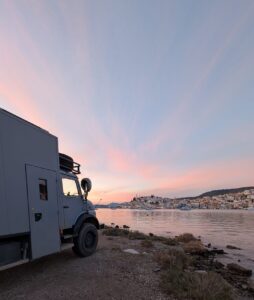
There were some fantastic park-ups, including places right beside the sea, and were never moved on during our trip.
We continued to follow our usual parking-not-camping approach. We didn’t put chairs outside, set up awnings or otherwise turn our parking space into a campsite.
The important thing to remember is that the legal position can change, so don’t assume our experience means the same rules apply when you visit. Check the current regulations before travelling.
Winter Weather in Greece
Greece might be famous for sunshine, beaches and blue skies, but winter is still winter.
The weather certainly wasn’t an endless succession of warm beach days, but it was generally nicer than the UK and we had plenty of genuinely warm days.
We also had some fairly miserable weather, including heavy rain and lightning, and even snow when we first arrived. That said, the snow was in the mountains and the weather varied considerably depending on where we were.
If you’re travelling overland through Greece during winter, particularly if you’re heading inland or into the mountains, don’t assume the Mediterranean climate means you can leave your winter gear at home.
The Cost of Overland Travel in Greece
Greece wasn’t the cheapest country we’ve travelled through, but we also didn’t find it particularly expensive by UK standards.
Fuel averaged around £1.37 per litre during our trip. Obviously these prices fluctuate and the average was brought up by the global fuel price increases in March 2026.
For food shopping, we mostly used Lidl and My Market. This was largely because they were usually relatively easy to access and park at. Sklavenitis is another supermarket chain worth looking out for.
Some of the prices we paid included:
- 500g packet of mince – around €6
- Sliced loaf of bread – around €1.80
- Oranges – around €1.90 per kg
- Chicken gyros wrap – around €4.50
Eating out was generally pretty reasonable, particularly if you stuck to local food rather than tourist-focused restaurants.
Mobile Internet
We didn’t need to buy a Greek SIM card because our regular UK mobile contracts allowed us to use our usual data through roaming.
As always, check your own provider’s current roaming arrangements before travelling, as these can change.
Water
Water was slightly more complicated.
We didn’t always find it particularly easy to fill our freshwater tank, so it was something we had to keep an eye on rather than simply assuming we’d find a tap whenever we needed one.
There are public fountains and taps scattered around though, and we were able to use these to top-up when necessary.
Our Favourites
Historic Sites in Greece
Greece is absolutely packed with historic sites.

You can barely turn a corner without stumbling across ancient ruins, Byzantine churches or some other reminder that people have been living here for thousands of years.
One of the best things about travelling overland through Greece during the winter is that the country actively encourages visitors to explore its historic sites outside the main tourist season.
State-run archaeological sites, historic sites, monuments and museums have free admission on the first and third Sunday of every month from 1 November until 31 March. There are also several other free-entry dates throughout the year.
This allowed us to visit both Mystras and Dion for free.
While they knock the prices down over winter, they also reduce the opening hours at many sites, so it’s worth checking before setting off. There’s no point arriving at a site at 4pm in December only to discover that you’ve missed the last admission!
Meteora
Meteora is one of those places that photographs really don’t do justice.
The area is famous for its enormous sandstone rock pillars. Some rise more than 400 metres above the surrounding landscape, with monasteries perched dramatically on top. Monks began settling among the rocks as early as the 11th century, and eventually 24 monasteries were built here. Today only a handful remain active.
We parked on the outskirts of the village of Sarakina and set off early, early for us, anyway, to reach the monasteries when they opened at 9am.
The drive takes you past several of the monasteries, so we made plenty of stops to admire the views.
We decided to focus on just one monastery, Varlaam. It has a large parking area and, by the time we returned to the truck, the car park and surrounding road were getting fairly busy. That was enough for us.
You could easily spend much longer exploring Meteora, but even a short visit gives you an appreciation for just how extraordinary the landscape is.
Mystras
Mystras is a medieval Byzantine settlement built into the hillside above Sparta.
The original fortress was built in 1249, and the settlement subsequently became an important centre of Byzantine power in southern Greece. The town was eventually abandoned as its residents gradually moved down to modern Sparta during the 19th century, leaving the atmospheric ruins behind. Surprisingly though, and despite the ancient appearance, the last inhabitant only moved out in 1953!
We took advantage of one of the free Sundays and visited with our overland friends Anna and Zoltan. There were loads of twisty little streets, churches and abandoned houses to explore.
We weren’t sure how busy it would be, so we arrived the night before and parked in the small carpark. Getting there early paid off. We were able to explore in the morning and leave just as the site was beginning to get busy.
Archaeological Site of Dion
Dion is an ancient archaeological site sitting beneath the impressive backdrop of Mount Olympus.
The site contains the remains of an ancient sacred and urban centre, including temples, baths, theatres, roads and other structures. The archaeological site currently lists a €10 full admission price, although we visited during one of the free-entry Sundays.
The weather was absolutely awful on the day we visited. It was so bad that Stuart decided not to come exploring, but I wasn’t wasting the free-entry day and went off on my own.
Despite the rain, I wandered around the ruins, which are spread across quite a large area.
I didn’t see everything. Some sections were closed or covered for winter maintenance and, between that and the constant rain, I was a bit selective about where I went. Still, it was an interesting site and well worth exploring.
We stayed in the attached car park the night before, befriended the local dogs and bought some cheap and tasty gyros from a nearby takeaway.
The Dragon Houses of Styra
The Dragon Houses are some of the more unusual ancient structures we came across on our overland trip in Greece.
These strange stone buildings are scattered around southern Evia, particularly around Styra and Mount Ochi. They’re built from enormous blocks of stone without mortar, with huge slabs forming their roofs. Their exact date and original purpose are still debated. Theories range from shepherd dwellings to farm buildings, watchtowers and religious structures.
The name comes from local folklore, which says that they were built by dragons, although the ancient Greek idea of a dragon was rather different from the fire-breathing creatures we tend to imagine today.
It was a steep and winding road to reach the car park, but there was a nice spacious area at the top where we were able to spend the night.
The hike to the ruins was short but a little tricky. The ground was rough and slippery, so we took our time getting up. We also continued past the houses towards the top of the hill, picking our way up through the scree slopes for some fantastic views.
Some of Greece’s Best Driving Roads
Greece is home to some of the most stunning roads we’ve ever driven in our overland truck.
There are coastal routes that look like they’ve been lifted straight from a Greek holiday brochure, with crystal-clear water and golden beaches running alongside the road.
Then there are rugged mountain passes, rocky overhangs and enormous views that make you feel tiny, even when you’re driving a big old lorry.
Route 82 – Langada Pass
One of our favourites was Route 82 across the Peloponnese. The route runs between Sparta and Kalamata, crossing the Taygetos mountain range through the Langada Pass.
There are plenty of switchbacks, rocky tunnels, overhangs and long drops into the ravines below. Fortunately, the road wasn’t overly narrow and was pretty quiet, so we had no problems getting the lorry through.
We didn’t manage to drive the far western section because of a road closure. The diversion was apparently only suitable for cars, so we didn’t risk it. We turned around and headed back to Sparta, happy to have completed the eastern part.
Charakas Pass
A route which came highly recommended to us was the Charakas Pass, also on the Peloponnese. The road is carved into the rocky cliffs with steep views down towards the sea.
There are a couple of overhangs, but the more daunting sections were the narrow, blind corners with absolutely no safety barrier. Luckily it was very quiet when we drove through, and it was completely manageable in the truck.
The tightest part was squeezing through the little village of Kyparissi, where narrow streets, tight corners, and low balconies jut out into the road.
Steni Dirfys Pass
The Steni Dirfys Pass on Evia Island was another firm favourite. The route crosses the middle of the island, from Kymi to Steni Dirfyos and on towards Nea Artaki.
We hadn’t really heard much about this road before travelling it, but it turned out to be well worth the detour. The scenery changed constantly as we travelled from the coast, through forests and up into the high rocky slopes. The views were seriously impressive.
I know the battery and storage capacity on my phone definitely suffered because of it!
Greek Beaches
Aside from ancient history, Greece is probably best known for its beaches.
The sandy bays, crystal-clear water and relatively mild winter temperatures make them particularly appealing to overlanders.
In the busiest tourist areas, getting close to the beach with a camper isn’t always straightforward unless you’re using a campsite.
But once you get away from the main resorts, we found plenty of beautiful coastal spots where we could park for the night.
Elea Beach
Elea Beach on the Peloponnese is something of a Mecca for campervan and overland travellers in Greece.
Some people appear to stay there long-term, and generally everyone seems to be left to their own devices. There are even locals who come around selling bread, jams and other supplies. According to some of the signs, there’s even a laundry service that comes to the beach.
You can understand why people arrive for a few days and end up staying for weeks.
Unfortunately, after some storms the beach was pretty dirty, but we spent some time helping with the clean-up and were still able to enjoy some time in the water as the spring temperatures heated up.
Voidokilia Beach
Voidokilia is a stunning horseshoe-shaped bay with beautifully clear water. It’s bordered by the Gialova Lagoon on one side and the Ionian Sea on the other.
We walked up to an ancient Mycenaean tomb overlooking the beach and then continued across towards the little cove at Glossa Beach.
Unfortunately, overnight parking isn’t permitted here because the area is protected. Instead we simply stopped to explore during the afternoon then moved on.
Fokianos Beach
Fokianos is another favourite of ours on the Peloponnese. It’s a remote pebble beach with calm, clear water that looked perfect for swimming.
There was some uncertainty about overnight parking in the main beach parking area. Instead we parked beside the little open taverna. We had a snack and a drink there, and the owner was happy for us to stay.
The beach can be reached either via the simpler northern route or by coming over the Kyparissi Pass.
Hot Springs in Greece
One of our favourite things to seek out when we’re travelling overland for months, even in Greece, is a nice hot spring. For us, being able to sit in naturally hot water outdoors is a real luxury, so we do tend to go looking for them. Fortunately, Greece has plenty.
Thermopylae Hot Springs
We found the springs around Thermopylae to be quite nice.
There are several pools scattered around the area, so we simply picked the one with the best Park4Night reviews. Some of the other locations had reviews mentioning security concerns and people ‘lurking’ around, so we decided not to take any chances.
The pools at 38.8034639, 22.4978274 weren’t the hottest we’d ever visited and there was quite a bit of algae, but we could park the truck right beside them.
The setting was lovely too. We spent time birdwatching while soaking in the water, not a bad way to spend an afternoon.
Loutra Edipsou
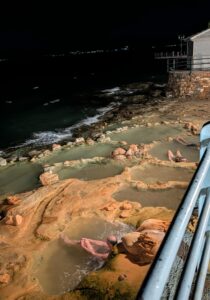
The warmest spring we found was on Evia Island, in the little coastal town of Loutra Edipsou.
This was our first proper in-town and coastal hot spring, which made it a bit different from the more natural springs we’d visited elsewhere, in Spain or Italy.
We parked at the nearby sports ground and walked for about five minutes down to the beach.
Here, hot water pours from a ground-fed pipe into a series of rocky pools. The water has been directed and managed to create baths at different temperatures.
Because they’re right on the beach, the waves occasionally wash into the outer pools. You can actually alternate between sitting in steaming hot water and jumping into the refreshing sea.
There are plenty of other springs dotted around Greece too, with different temperatures and varying levels of infrastructure. There are also plenty of paid options, although we didn’t bother with those.
Other Interesting Places
Vikos Gorge
Vikos Gorge is another one of those places that makes you feel very small.
It’s part of the Vikos-Aoos National Park and is famous for being listed by Guinness as the deepest canyon in the world in proportion to its width. The gorge reaches depths of around a kilometre in places, although the exact record claim is sometimes disputed.
Standing at the viewpoint and looking down into the almost bottomless depths gives you a real sense of perspective. It was absolutely freezing and windy when we visited, so we didn’t hang around for too long.
The drive up was spectacular though. We were there in late November and had already encountered some snow in the mountains.
There’s a small car park at the end of the road, although we only used it to turn around before parking further back in a little lay-by so that we didn’t fill the main car park.
Petrified Forest of Agios Nikolaos
This one probably won’t appeal to everyone, but if you’re interested in ancient natural history, it’s well worth a look.
The petrified forest is more than two million years old. Volcanic and seismic activity buried the trees, with minerals gradually replacing the original organic material and turning the remains to stone.
Don’t expect to see perfectly preserved stone leaves and branches. Most of what remains are tree trunks and impressions in the rock.
Even so, the combination of the fossilised forest and rugged coastal setting makes it an unusual place to visit.
There’s a small car park, with additional lay-bys further back, but we heard mixed reports on if you’re allowed to stay overnight in the area, so double check your park-up options and have a back-up just in case.
Lake Aoos
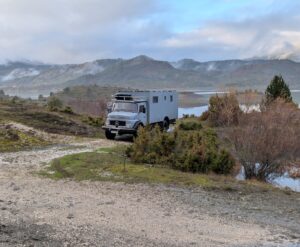
Lake Aoos was another place I hadn’t expected to enjoy quite as much as I did. It’s the highest-altitude artificial lake in Greece and, when we arrived, the landscape looked more like Scotland than the Mediterranean.
Snow-capped peaks and pine forests surrounded the lake, with mist rolling across the water.
The road around the lake was fairly rough, particularly on the northern side, but we found a fantastic park-up beside the dam.
As the sun set, we watched a couple of hares racing around on the road through the mist. It was a completely unexpected highlight.
Greek Towns
Looking back, we actually didn’t spend a lot of time exploring the Greek towns which was
unfortunate. I think we found so many gorgeous rural places to explore we just didn’t get around to venturing into urban areas very often. Think we may have to rectify this next time because the towns we did visit were all pretty nice.
Nafplio
We visited Nafplio multiple times while travelling around the Peloponnese.
It’s a convenient place to stop when moving around the peninsula, with a useful park-up near the marina.
There’s plenty to explore, from the winding streets and coastal paths to the pretty buildings and the fortresses overlooking the town.
We went on several walks and ate out a couple of times while we were there.
This town seems to be another popular spot for those travelling overland through Greece. We met a few other travellers while we were there.
Poros
Poros was an easy island trip for us. We parked in the spacious free parking area at Galatas and took the little ferry across, which cost just €1.30 each.
We hiked up to the old windmill and Saint Anargyri Chapel for some great views. From there we wound our way back down through the charming white-painted, cobbled streets.
It’s definitely a touristy little place, but during our visit it was quiet enough to enjoy.
Monemvasia
Monemvasia is a medieval fortified town built on a huge rocky island connected to the mainland by a narrow causeway.
The settlement was founded by the Byzantines in the sixth century and has subsequently been occupied by Byzantines, Crusaders, Venetians and Ottomans. Today, the lower town remains a maze of stone buildings, churches and narrow cobbled streets,
while the upper town is largely uninhabited ruins. There was quite a lot of renovation and reconstruction work happening during our visit, but there were still plenty of little nooks and crannies to explore.
There are absolutely no vehicles in the old town. Everything has to be brought in using carts, buggies and, in some cases, donkeys. This really adds to the feeling that you’ve stepped back in time.
There was a parking area on the edge of the tombolo where we left the truck and walked into town.
We could have hiked up to the fortress at the top of the rock, but my knee wasn’t particularly enthusiastic about that idea, so we stuck to the lower levels.
Places We Didn’t Visit But Probably Should Have
One of the problems with travelling overland around Greece is that there is simply too much to see.
We deliberately avoided trying to cram everything into one trip, knowing that we’d rather enjoy a smaller part of the country properly and have a reason to come back.
There are several places that therefore remain firmly on our list.
Delphi
Delphi was probably the biggest archaeological site we missed.
The ancient sanctuary was considered the religious centre of the Greek world, and the Oracle of Apollo attracted visitors from across the ancient Mediterranean. The site is spectacularly positioned between the cliffs of Mount Parnassus and is now a UNESCO World Heritage Site.
It definitely sounds like somewhere worth visiting, although parking is limited.
If you’re travelling in a large vehicle, we’d recommend planning ahead, arriving early and avoiding the busiest periods.
You can’t stay overnight in the archaeological site’s parking area, but there are roadside options and campsites nearby, some of which offer transport into Delphi.
Mount Olympus
Greece’s highest mountain was another one we would have liked to explore.
Mount Olympus is famous in Greek mythology as the home of the gods, but it’s also an impressive natural destination in its own right.
We’d have loved to spend some time hiking through the National Park. However, with winter weather setting in, we decided to leave it for another trip.
There are numerous parking areas and access points around the mountain, so we’d definitely like to return with more time and better weather.
Athens
We’re not particularly big-city people, so Athens was never high on our list.
We were actually nearby a couple of times while collecting and dropping off Stuart’s mum at the airport, but we decided not to travel into the city.
That doesn’t mean we don’t appreciate what is there.
The Acropolis and Parthenon are among the most important surviving monuments of the ancient Greek world. The Acropolis complex includes the Parthenon, Erechtheion, Propylaea and Temple of Athena Nike, and is recognised by UNESCO as an outstanding example of Classical Greek architecture.
Maybe next time we’ll park in one of the surrounding towns and take public transport into Athens instead.
Mycenae
Mycenae is another definite one for our next overland trip to Greece.
The ancient city was one of the most important centres of the Mycenaean civilisation, which dominated much of the eastern Mediterranean between roughly the 15th and 12th centuries BC.
It’s particularly famous for the Lion Gate and the Treasury of Atreus, and the site is closely connected with the Homeric epic.
We actually had to choose between Mycenae and Mystras for one of the free Sundays because the normal admission price was €20
each. Mystras was closer, so it won.
There is plenty of parking at Mycenae, although you can’t stay there overnight. Nafplio is nearby and makes a convenient base for visiting the site.
Would We Travel Overland in Greece Again?
Absolutely.
Greece turned out to be a brilliant country for overland travel, particularly during the quieter winter months.
We found a good mixture of beautiful beaches, spectacular mountain roads, ancient ruins, unusual natural sites and plenty of places where we could simply stop and enjoy being somewhere.
The country is also big enough that you can easily spend several weeks exploring without feeling like you’re constantly driving from one tourist attraction to another.
Our biggest piece of advice would be don’t try to see everything. We spent a good chunk of our 2026 overland trip travelling around Greece and still left with a sizeable list of places we hadn’t visited.
Take your time, get off the main tourist routes when you can and don’t be afraid to follow a road simply because it looks interesting.
Just remember to check the current motorhome regulations, keep an eye on the weather if you’re heading into the mountains and make sure your satnav knows just how big your vehicle really is. And if you find yourself squeezing a 10-tonne lorry through an olive grove because Google Maps told you it was a shortcut, well… don’t say we didn’t warn you.
If you’re interested in overland travel elsewhere, or really enjoyed our Greece write-up check out our travel section to see our other National Guides.


Pingback: Overland Through Turkey - Orkney Overlanders